
Virtual AI Assistant: Operational Systems and Automation Frameworks for 2026
Hiring more people to manage operational chaos is a mathematical error. If your business relies on manual admin and inconsistent follow-up, adding headcount only scales the inefficiency. You likely face software fatigue and high labor costs for basic tasks that should be automated. It's time to stop treating technology as a tool and start treating it as a system operator. Systems first, people second.
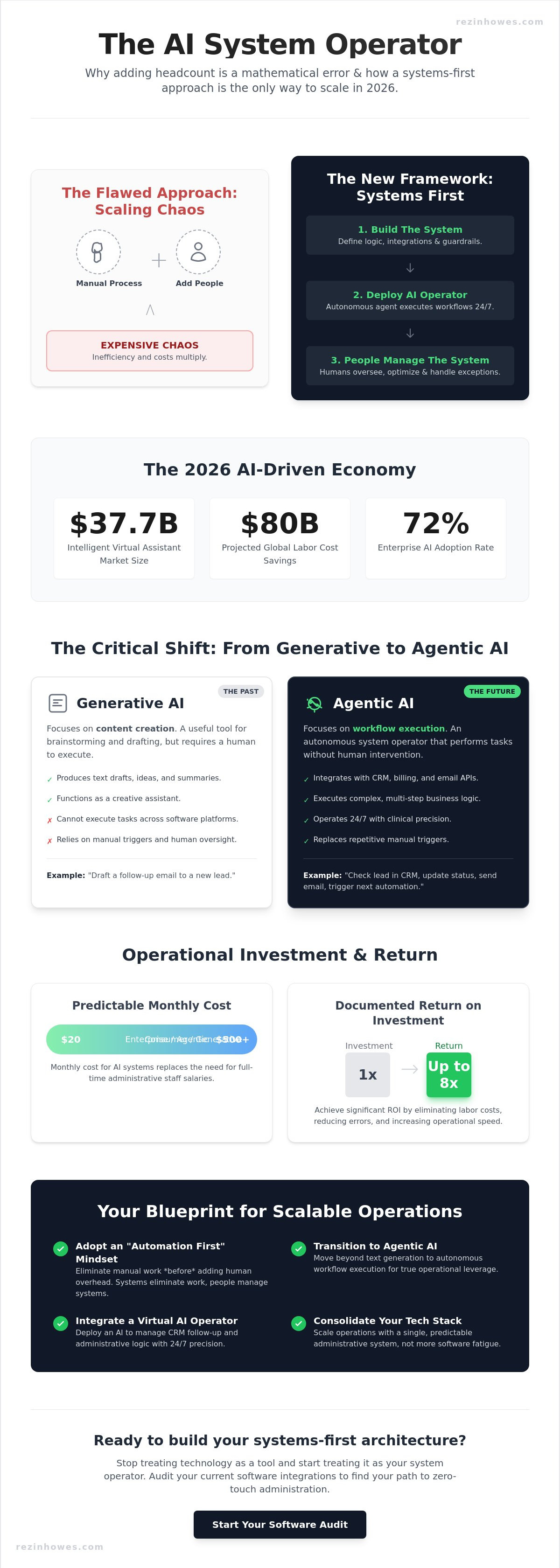
Integrating a virtual ai assistant into your framework is the only way to scale without increasing headcount in 2026. With the intelligent virtual assistant market reaching $37.7 billion this year, the technology is now a core production requirement for serious enterprises. You'll learn how to deploy autonomous agents that handle CRM integration and administrative logic with clinical precision. Businesses implementing these systems in 2026 are already reducing contact center labor costs by a projected $80 billion globally. We will break down the specific automation frameworks and pricing structures, ranging from $20 to $500 monthly, required to achieve a documented ROI of up to 8x while eliminating manual operations for good.
Key Takeaways
- Transition from generative AI to agentic AI to execute business workflows autonomously rather than just producing text drafts.
- Adopt an "automation first, people second" framework to eliminate manual work before adding human overhead and operational complexity.
- Integrate a virtual ai assistant as a dedicated system operator to manage CRM lead follow-up and administrative logic with clinical precision.
- Identify and replace repetitive manual triggers with automated sequences to ensure consistent execution without the need for constant oversight.
- Scale operations by consolidating software tools into a single, predictable administrative system that functions without increasing headcount.
Defining the Virtual AI Assistant in a Systems-First Economy
A Virtual assistant used to be a human contractor you hired to manage your calendar or respond to basic emails. By 2026, this definition has shifted toward the virtual ai assistant as a functional system operator. This isn't a chatbot that simply generates text; it's an autonomous agent designed to execute complex business logic. It operates within your CRM and billing software to perform tasks without human intervention. The era of manual-first administrative staffing ended when enterprise AI adoption hit 72% this year. Businesses that continue to prioritize human labor for repetitive tasks are choosing high overhead and operational friction.
The core difference lies in the transition from generative AI to agentic AI. Generative tools focus on content creation. Agentic AI focuses on workflow execution. It doesn't just draft a follow-up email; it checks the lead status in your CRM, updates the record, and triggers the next automation sequence. Consumer-grade tools like ChatGPT Plus ($20/month) are useful for brainstorming, but enterprise-grade assistants are built for execution within a specific operational framework. They are the silent partners managing the infrastructure of your business.
To better understand how these agents function in a live business environment, watch this breakdown of autonomous field agents:
The Evolution of Administrative Automation
Traditional automation relied on rigid triggers that broke whenever a client deviated from a script. Modern Large Language Models (LLMs) have replaced these fragile systems with context-aware decision engines. These engines interpret business logic rather than just following a line of code. If a client emails about a billing discrepancy, the virtual ai assistant identifies the intent, accesses your billing platform, and drafts a resolution based on your predefined guardrails. Traditional virtual assistant models are failing because they can't match the 24/7 speed and sub-second response times required in a $538 billion AI-driven market.
Core Capabilities of Autonomous Agents
Enterprise-grade assistants provide cross-platform execution by moving data between your CRM, email, and billing platforms with zero manual entry. They use natural language processing for lead triage, identifying high-intent prospects before a human ever touches the file. These agents operate within strict operational guardrails, ensuring compliance with new regulations like the Colorado AI Act of 2026. This isn't just another tool in your stack; it's a managed system designed for scalability. For owners ready to move away from "hustle" and toward structured execution, auditing your current software integrations is the first step toward a systems-first architecture.
The Operational Framework: Automation First, People Second
Hiring a human to fix a broken process is a financial liability. It creates expensive chaos. You don't need more hands; you need better logic. The Rezin Howes philosophy is absolute: systems eliminate work. People manage the systems. Adding labor to a chaotic operation only scales the chaos. A virtual ai assistant functions as a system operator, not a task-doer. It requires a technical framework to deliver ROI. Most firms fail because they treat AI as a "cool tool" rather than the foundation of their business infrastructure.
Zero-touch administrative workflows require a specific CRM and software stack. Without deep integration, you're just adding another login to your daily fatigue. Effective AI Automation relies on tools that communicate via API without manual triggers. For example, Microsoft Copilot Studio allows businesses to build custom assistants for $200 per month. This isn't an expense; it's a structural investment that replaces the need for entry-level admin staff. If your tools don't talk to each other, your automation will break under the slightest pressure.
Building the Digital Infrastructure
Standardizing inputs is the first technical requirement. AI cannot interpret messy, unstructured data. Your inputs must be formatted for machine consumption to avoid algorithmic errors. This requires an API-first architecture to bridge the gap between your CRM and billing software. Centralizing your logic in a platform like GoHighLevel prevents data silos. It ensures every automated action is based on real-time, accurate information. A unified data environment allows your virtual ai assistant to execute workflows with clinical precision, reducing the need for human oversight by up to 90% in routine departments.
Mapping the Decision Matrix
Distinguishing between rules-based and discretionary tasks is essential for scaling. Rules-based tasks follow a logical "if-then" structure. Your AI system should handle 80% of these routine inquiries, including lead triage and appointment scheduling. Discretionary tasks require human intuition and high-level strategy. Program your system to flag these specific scenarios for human intervention. This prevents the AI from overstepping its guardrails while ensuring you only focus on high-value work. If your current setup feels like a patchwork of tools rather than a cohesive system, you should audit your operational logic before adding more labor to the mix.
AI Virtual Assistant vs. Human Managed Staffing: Navigating the Hybrid Model
Comparing human managed staffing to autonomous systems is a matter of capital efficiency. Human virtual assistants command rates between $10 and $100 per hour depending on their specialization and location. In contrast, a virtual ai assistant typically operates on a fixed monthly subscription ranging from $20 to $500. The cost discrepancy is significant, but the real value lies in reliability. AI doesn't require sick leave, benefits, or management overhead. It executes tasks with 100% consistency 24 hours a day, providing a level of availability that human staffing cannot match without massive expense.
The "Hybrid Operator" model is the strategic standard for 2026. Allied Assist leverages this synergy by positioning human staff as system supervisors rather than task-doers. They don't spend hours on manual data entry or basic lead follow-up. Instead, they audit the outputs of the AI agents to ensure total accuracy. This approach ensures your business maintains a human touch for high-stakes decisions while benefiting from machine speed for routine operations. It's a move toward consolidated, managed systems that prioritize execution over manual effort.
When AI Outperforms Human Labor
Speed and volume are the primary areas where AI wins. A virtual ai assistant handles high-volume data entry and technical troubleshooting without fatigue. Conversational AI is projected to save businesses $80 billion in contact center labor costs this year alone. Reporting is another critical advantage. AI synthesizes financial data and provides instantaneous updates across your entire organization. A human assistant might take several hours to compile a report that an autonomous agent generates in seconds. If the task is rules-based and repetitive, the machine is the superior choice.
The Irreplaceable Human Element
High-stakes service industries like childcare or healthcare still require human intervention for complex emotional escalations. Algorithms lack the empathy needed to navigate a frustrated parent or a medical emergency. Humans are also essential for strategic pivoting when external market conditions shift suddenly. They act as the final check on AI logs to ensure every interaction aligns with brand ethics and safety frameworks. The system performs the labor, but the human ensures the quality and direction of the output.
The myth of "impersonal AI" stems from poor implementation. An autonomous agent is only as cold as the logic you program into it. When integrated correctly into your CRM, it provides faster and more accurate answers than an overworked admin staff. It removes the friction of waiting for a response. Speed is the highest form of customer service in 2026. If you want to scale without burnout, you don't choose between people and software. You choose both, but you lead with the system.
Implementing AI Automation in Service-Based Enterprises
Operational "hustle" is a symptom of a broken system. Manual triggers in your workflow are leaks that drain profit and focus. The first step toward a lean operation is a comprehensive audit of repetitive tasks. Identify every instance where a staff member manually copies data, sends a standard follow-up, or confirms an appointment. These are not human-value tasks; they are algorithmic triggers. By 2026, 72% of enterprises have already moved these functions to automated frameworks to maintain competitive margins.
Deploying a virtual ai assistant as your primary lead secretary is the second step. High-intent leads require immediate response. A machine doesn't hesitate or forget. It engages prospects instantly, qualifying them based on your specific business logic. Once the lead is scored, the system manages the high-intent follow-up while moving cold prospects into a long-term nurture sequence. This ensures your human staff only interacts with "ready-to-buy" opportunities, maximizing their hourly value. Businesses using this model report an ROI between 3.5x and 8x on their automation spend.
Scheduling is the third pillar of the zero-touch workflow. Back-and-forth email chains for tour bookings or consultations are obsolete. Your assistant integrates directly with your calendar to provide real-time availability and instant confirmation. Finally, you must establish a "System Operator" role. This person doesn't do the work; they monitor the health of the automation. They audit logs, check for API connectivity, and ensure the virtual ai assistant remains within its operational guardrails. You are building a machine, not just hiring help.
Case Study: Automation in Childcare Operations
Waitlist management is a primary source of chaos for childcare owners. Manual spreadsheets lead to lost revenue and frustrated parents. Implementing a Childcare Virtual Assistant system automates the entire enrollment pipeline. The AI handles tour scheduling, synthesizes parent feedback from intake forms, and generates staff reports automatically. This removes the administrative burden from the Director, allowing them to focus on classroom quality rather than paperwork. It's a move from "running a center" to "operating a system."
Lead Triage and CRM Optimization
Speed to lead is the most critical metric in a service-based economy. You must reduce this to under 60 seconds to capture modern consumers. AI scores leads in real-time, checking for budget, location, and urgency before alerting your team. This prevents your CRM from becoming a graveyard of uncontacted prospects. If your current lead response time is measured in hours rather than seconds, you are losing market share to automated competitors. To fix your lead flow, you should schedule a systems audit to identify your primary automation gaps.
Scaling Without Burnout: The Future of Managed AI Systems
Adding more tools to a scaling firm is a tactical error. It leads to tool sprawl, where data silos and redundant subscriptions create a software tax on your bottom line. Effective scaling requires consolidation, not addition. A virtual ai assistant should serve as the central node of your operation, not just another tab in your browser. By 2026, 72% of enterprises have adopted AI to streamline at least one core function. These firms aren't looking for more apps; they're building consolidated, managed operational systems that deliver predictability. Predictability is the only asset that allows for scaling without a corresponding increase in stress or headcount.
Transitioning from a "business doer" to a "system owner" is the final stage of operational maturity. You must stop hiring people to solve problems. Instead, use automation to eliminate the problem at its source. Deploying custom AI agents via no-code platforms now takes between 2 and 14 days. This rapid deployment allows you to bridge automation gaps that generic templates cannot touch. If you're ready to move away from the daily grind, you must book a call to audit your systems and identify where your infrastructure is leaking capital.
Eliminating Operational Friction
Operational friction is caused by manual hand-offs between disconnected software. Custom software and API integrations bridge these gaps, ensuring data flows autonomously between your CRM and billing units. This reduces the cognitive load on your human staff. When your tech stack is consolidated, your virtual ai assistant can execute workflows with sub-second response times. This level of efficiency is required to compete in an AI market currently valued at $538 billion. A streamlined system is a predictable system, and a predictable system is a profitable one.
Building for Long-Term Exit or Passive Ownership
Passive ownership is impossible without structured systems. You must create Standard Operating Procedures (SOPs) that are machine-readable. AI cannot execute vague instructions. Your SOPs must be programmed into your automation framework as logical decision trees. The 2026 roadmap for autonomous business management focuses on agentic workflows where the system handles the execution while you handle the strategy. This move toward managed AI systems allows for a potential exit or a transition to a "silent partner" role. Stop hiring to fix chaos. Start automating to achieve total operational precision.
Executing the 2026 Operational Roadmap
Operating a business in 2026 requires a shift from manual labor to system-driven execution. You've seen how agentic AI moves beyond text generation to perform actual workflows. By prioritizing automation over headcount, you eliminate the high labor costs and operational friction that stifle scaling. A virtual ai assistant isn't a luxury for large firms; it's the baseline requirement for service providers who value predictability and speed.
As the founder of Allied Assist and an expert in GoHighLevel CRM automation, I've seen how specialized childcare operational systems transform chaotic centers into systematic assets. You don't need more staff to manage your waitlist or follow up with leads. You need a digital infrastructure that functions without your constant oversight. The transition from "hustle culture" to structured ownership starts with a technical audit of your current logic. Stop hiring to solve problems. Start automating to eliminate them.
Eliminate operational chaos. Book your systems audit today. You can build a business that runs itself.
Frequently Asked Questions
What is the difference between a virtual AI assistant and a standard chatbot?
Standard chatbots are reactive tools that provide text based on simple keyword triggers. A virtual ai assistant is an agentic system designed to execute complex workflows across your software stack. It doesn't just talk; it performs actions like updating CRM records, triggering billing sequences, and managing lead status. While chatbots are limited to conversation, these assistants function as autonomous system operators within your business infrastructure.
Can an AI powered virtual assistant actually handle phone calls and scheduling?
Yes, modern conversational AI manages real-time scheduling and voice interactions with clinical precision. These systems integrate directly with your calendar to provide instant tour or consultation confirmations without human intervention. This technology is projected to reduce contact center labor costs by $80 billion in 2026. It eliminates the back and forth friction of manual scheduling, ensuring your lead response time remains under 60 seconds.
How much does it cost to implement a virtual AI assistant system in 2026?
Small business AI assistant costs range from $20 to $500 per month for subscription-based models. Enterprise-grade platforms like Microsoft Copilot Studio are priced at $200 per month. If you require a custom-built solution, basic development starts at approximately $5,000. Implementation time has decreased significantly, with typical deployments now taking between 2 and 14 days to reach full operational capacity.
Is my business data secure when using AI virtual assistants?
Security is managed through strict adherence to emerging regulations like the Colorado AI Act and the EU AI Act. By August 2, 2026, all high-risk AI systems must comply with transparency and governance rules to prevent algorithmic discrimination. Enterprise-grade assistants use encrypted API connections to move data between your CRM and billing tools. This ensures your proprietary information remains protected within a secure, managed framework.
Do I still need a human virtual assistant if I have AI automation?
Human virtual assistants are still required for strategic oversight and complex emotional escalations. The hybrid model uses a virtual ai assistant to handle 80% of repetitive, rules-based tasks while humans audit the system logs. This allows your human staff to stop doing $20 per hour admin work and focus on high-level strategy. Automation eliminates the manual labor, but humans ensure the system remains aligned with your brand voice.
What is the best CRM for integrating an AI powered assistant?
GoHighLevel is the primary choice for service-based businesses requiring deep automation and centralized logic. It supports an API-first architecture that allows your AI agents to access real-time data across all departments. This prevents the data silos often found in older, disconnected software stacks. Using a unified CRM ensures your assistant can execute workflows across lead triage, appointment setting, and long-term nurture sequences without breaking.
How do I start automating my childcare or service-based business?
Start by auditing your current operational "hustle" for repetitive manual triggers. Identify every task that requires a staff member to manually copy data or send a standard follow-up. Move these functions to an automated system before you consider hiring more labor. This "automation first" approach ensures you can scale your enrollment or service volume without increasing your monthly headcount or operational stress.

Article by
Rezin Howes
Rezin Howes is an entrepreneur and co-founder of Allied Assist, specializing in helping business owners eliminate inefficiency through automation, streamlined systems, and strategic virtual assistant support. He works with overwhelmed entrepreneurs to reduce manual work, improve operations, and build businesses that run without constant owner involvement.
If you’re ready to stop being the bottleneck in your business and start operating with real efficiency, book a call to map out your automation and delegation strategy.
Disclaimer
The information provided on this website is for educational and informational purposes only and is based on personal experience, industry knowledge, and general business practices. It is not intended as legal, financial, or professional advice.
Every business is unique, and results will vary based on individual circumstances, implementation, and market conditions. You should consult with a qualified professional before making any business, financial, or operational decisions.
While we strive to provide accurate and up-to-date information, we make no guarantees regarding the completeness, reliability, or outcomes of applying any strategies discussed.
By using this website, you acknowledge that you are responsible for your own decisions and results.