
Virtual Assistant: Operational Infrastructure and Managed Staffing Systems
Hiring a virtual assistant to "help out" is the fastest way to increase your management overhead. Most business owners treat remote staffing as a task-based band-aid. You hire a freelancer, spend 40 hours vetting them, and realize you've just traded operational tasks for a management role you didn't want. It's a cycle of unpredictable output and technical gaps. You need a system, not a person.
We agree that managing freelancers is exhausting. This guide provides a pragmatic framework for integrating managed virtual assistance into your operations to drive systematic scaling. You'll learn how to leverage system operators rather than task doers. We'll explore how to use tools like HubSpot version 2026.03 and agentic AI to reclaim the 15 hours per week entrepreneurs typically lose to manual administration. This is how you build the infrastructure that replaces executive involvement with operational leverage.
Key Takeaways
- Transition from hiring a task-doer to onboarding a system operator who manages administrative and technical workflows.
- Evaluate the managed service model to reduce management fatigue and ensure predictable output compared to unmanaged freelance marketplaces.
- Leverage a virtual assistant to bridge the gap between CRM automation and human lead follow-up for higher conversion rates.
- Utilize a monthly retainer structure to stabilize operational costs while redirecting executive time toward high-revenue activities.
- Implement a phased integration strategy by auditing existing friction points and standardizing SOPs before adding remote labor.
Table of Contents
-
Virtual Assistant Functional Scope: Defining the Operational Role
-
Evaluating Virtual Assistant Models: Marketplaces vs. Managed Services
-
CRM Integration and Workflow Automation: The Technical Advantage
-
Financial Structures: Retainers, ROI, and Operational Scaling
Virtual Assistant Functional Scope: Defining the Operational Role
A virtual assistant (occupation) is no longer a temporary fix for a cluttered inbox. In 2026, the role has evolved into a remote operational partnership. You aren't hiring a person to do tasks; you are deploying a system operator to manage workflows. This shift from task-based delegation to system-based management is the difference between constant firefighting and predictable scaling. It requires a clinical focus on administrative and technical precision.
To better understand how the industry has shifted toward this professionalized model, watch this helpful video:
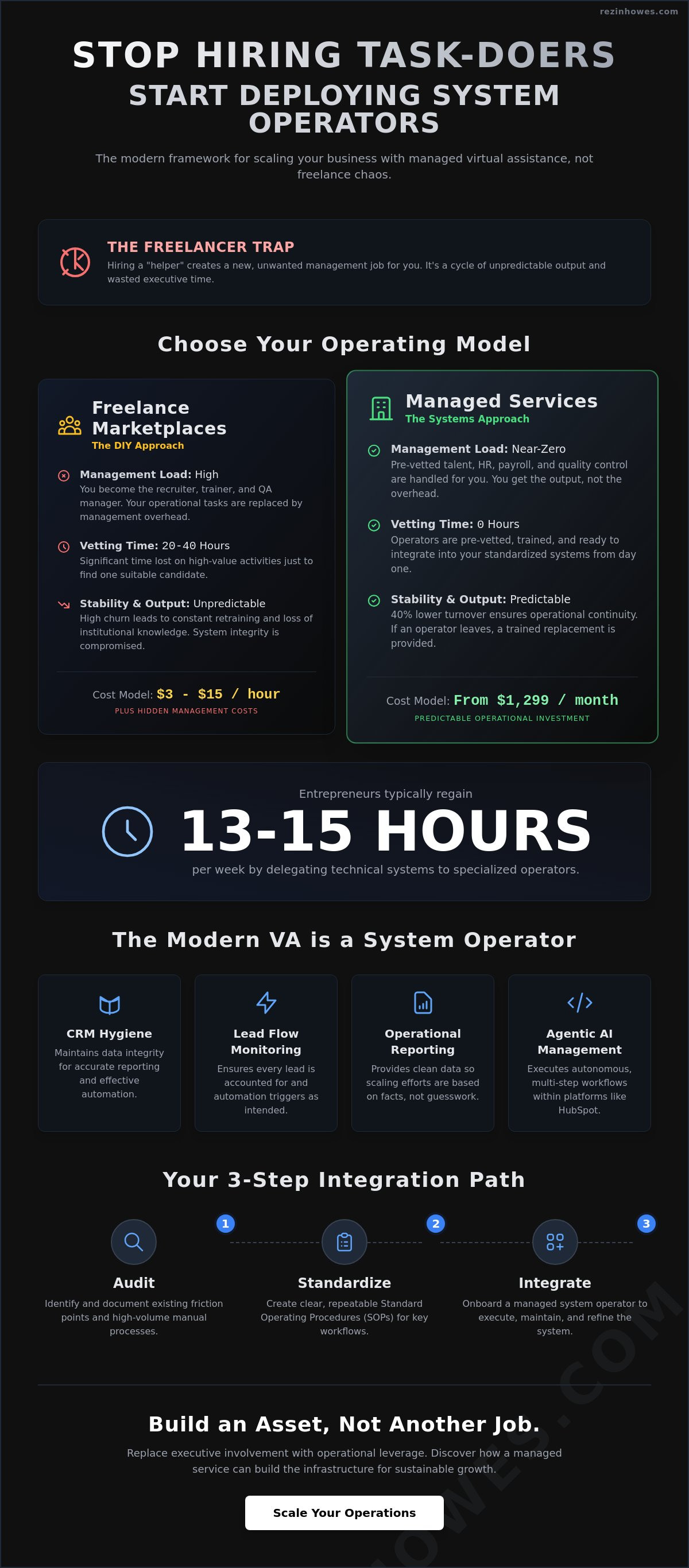
Core responsibilities now center on high-level infrastructure maintenance. This includes CRM hygiene, lead flow monitoring, and operational reporting. By 2026, a high-performing virtual assistant utilizes agentic AI to execute multi-step workflows autonomously. They don't just check email. They triage communications based on revenue potential and update your pipeline in real-time. Recent data from the Virtual Assistance Institute shows that entrepreneurs regain 13 to 15 hours per week by delegating these technical systems to specialized operators.
Administrative vs. Executive Operational Support
Distinction is critical for resource allocation. Administrative support focuses on high-volume, repetitive data entry and basic communication. It is purely transactional. Executive operational support involves strategic scheduling, priority management, and project oversight. This level of support requires a deeper understanding of your business goals. Most childcare and service-based business owners start with administrative support but fail to scale because they don't transition to executive-level systems. You must match the support level to your current revenue phase. Standardized workflows and predictable results are the only metrics that matter here.
Technical Integration: The VA as a Systems Operator
Your software stack is only as effective as the data inside it. A virtual assistant functions as the guardian of digital infrastructure. They manage Slack channels, update project management boards, and ensure clean lead flow through your CRM. In 2026, this includes managing agentic AI frameworks within platforms like Salesforce or Zoho. Data integrity is the primary goal. Without accurate reporting, your scaling efforts are based on guesswork. A systems operator removes that risk by maintaining a clinical, error-free back office. They ensure that every lead is accounted for and every automation triggers as intended. This is not assistance; it is operational maintenance.
Evaluating Virtual Assistant Models: Marketplaces vs. Managed Services
Choosing a staffing model is a calculation of management capacity. Marketplace platforms like Upwork or Fiverr offer low entry costs, often between $3 and $15 per hour for offshore talent. However, the unit price is deceptive. In this model, you are the recruiter, the trainer, and the quality assurance manager. Research indicates that vetting a single hire on these platforms can consume 20 to 40 hours of executive time. For an entrepreneur, this is a significant diversion from high-value activities. Reliability is a variable, not a constant.
Managed services prioritize operational continuity. These entities provide pre-vetted talent and handle HR, payroll, and quality control. While the monthly cost is higher, typically starting at $1,299 per month as of April 2026, the management tax is near zero. Managed services report a 40% lower turnover rate than freelance marketplaces. This stability is vital for maintaining the integrity of your SOPs. If your virtual assistant leaves, a managed service provides a replacement who is already trained on your specific systems. You pay for the result, not the recruitment process.
The Hidden Costs of Freelance Management
Independent contractors require constant oversight. Without a centralized management layer, you must build the infrastructure to monitor their output. Churn is the primary enemy of operational stability. Every time a freelancer leaves, your system resets. You lose the institutional knowledge they acquired. This creates a cycle of repetitive training that prevents scaling. Understanding the ROI of Hiring a Virtual Assistant requires factoring in these management hours. If you spend five hours a week managing a $10 per hour freelancer, your actual cost basis is significantly higher.
Managed Staffing: Eliminating Operational Friction
Managed staffing models provide centralized accountability. You have a single point of contact for performance issues. Onboarding is standardized. This reduces the time you spend explaining basic business functions. Billing is predictable. You avoid the administrative burden of managing multiple international invoices and tax forms. This model allows you to scale by adding seats rather than increasing your management workload. It's a plug and play solution for back-office infrastructure. For those ready to move beyond manual oversight, implementing an automated staffing system is the next logical step. Reliability becomes a line item in your budget rather than a daily anxiety. You gain the capacity to focus on revenue-generating strategy while your operational partner handles the mechanics.
CRM Integration and Workflow Automation: The Technical Advantage
Automation is not a self-sustaining miracle. It is a mechanical process that requires constant oversight. Most business owners treat their CRM as a static database. This is a mistake. A CRM is an operational engine. Without a dedicated operator, the engine stalls. Leads get stuck in pipeline bottlenecks. Automated sequences fail due to broken triggers. A virtual assistant acts as the system mechanic. They ensure the logic of your automation remains intact while handling the nuances that software cannot process. Systems first. People second. This is the hierarchy of scaling.
Data integrity is the baseline for growth. In 2026, agentic AI has shifted CRM capabilities from simple suggestions to autonomous execution. However, AI cannot manage the "human" element of a lead follow-up. It can't sense the urgency in a prospect's tone or handle complex objections that fall outside its training data. Your remote partner fills these gaps. They monitor the automated workflows and step in when a human touch is required to move a lead from acquisition to conversion. This hybrid approach ensures 100% lead coverage without increasing your personal workload.
GoHighLevel CRM: The Operational Backbone
GoHighLevel serves as the central nervous system for service-based businesses. It handles the heavy lifting of lead capture and initial outreach. Your virtual assistant manages this backbone. They update tags, move leads through pipeline stages, and audit automated sequences for performance. If a lead doesn't respond to a text bot, the VA initiates a manual follow-up. This prevents lead decay. They also generate daily reports on pipeline health. You stop guessing about your ROI. You start making decisions based on clinical data. The VA ensures that every dollar spent on marketing is tracked through the entire sales cycle.
Software and Tool Stack Optimization
Efficiency requires a clean tech stack. Fragmented tools create friction. We prioritize integrating your CRM with project management platforms like ClickUp or Asana. This creates a seamless flow of information. When a lead converts in the CRM, the VA triggers the onboarding workflow in your project management tool. Slack and email act as navigational signposts, not distractions. Communication is staccato and directed. The VA maintains these digital channels to ensure information reaches the right person at the right time. This is infrastructure management. It turns a chaotic collection of apps into a high-speed execution system that runs without owner oversight.
Financial Structures: Retainers, ROI, and Operational Scaling
Operational scaling requires a shift from transactional expenses to systematic investments. Most entrepreneurs evaluate a virtual assistant based on a simple hourly rate. This is a flawed metric. In-house administrative staff often carry hidden costs that inflate a $45,000 annual salary to a $70,000 total burden after payroll taxes, health insurance, and equipment are factored in. According to 2026 data, businesses can save up to 78% of operating costs by utilizing remote staffing instead of traditional hires. A monthly retainer model replaces variable chaos with budget predictability. You aren't buying time. You are securing operational capacity.
Understanding Monthly Retainer Fees
A retainer is a commitment to readiness. It covers the management oversight, technical support, and specialized software access required to run your business back-office. Unlike the "pay-as-you-go" marketplace model, a professional retainer ensures your systems are monitored consistently. This structure acts as a filter for serious scaling. It signals a move away from ad-hoc help toward a structured partnership. You pay for the infrastructure that allows your business to function without your constant intervention. It is a clinical allocation of resources designed for long-term stability and administrative precision.
Measuring ROI in Business Operations
Return on investment is calculated through three primary metrics. First, executive hours reclaimed. Entrepreneurs regain an average of 13 to 15 hours per week by delegating tasks to a virtual assistant. This time must be redirected to high-impact revenue activities to realize full value. Second, lead conversion increases. Systematic CRM hygiene prevents lead decay, which directly impacts the bottom line through better pipeline management. Third, the reduction in operational errors. Managed services report a 40% lower turnover rate than freelance platforms. This preserves institutional knowledge and prevents costly software misconfigurations. These outcomes are the true measures of financial success.
Transitioning from a single operator to a managed team is the final phase of operational scaling. As lead volume grows, the technical demands on your infrastructure increase. A single freelancer cannot scale with your business. A managed team provides redundancy. If one person is unavailable, the system continues to function. This continuity is essential for service-based businesses where a 24-hour delay in lead response can result in a lost contract. Managed services provide the professional oversight and standardized workflows required for predictable growth. For those ready to optimize their financial and operational structure, view our retainer-based service models to start scaling with precision. Efficiency is the only currency that matters in a competitive market.
Implementation Strategy: Integrating Managed Support
Successful integration is a technical deployment, not a casual introduction. Most staffing failures occur because owners skip the infrastructure phase. Phase 1 requires a clinical audit of existing workflows to identify friction points. You must pinpoint exactly where manual intervention slows down lead processing or service delivery. By April 2026, operational speed is a primary competitive advantage. If your current process relies on your personal memory or unrecorded habits, it's not ready for a virtual assistant. You are hiring a system operator, and operators require a manual.
Phase 2 focuses on standardizing SOPs for remote execution. These documents act as the logic gates for your business. Every repetitive task must be documented with enough precision that a new operator can execute with zero ambiguity. Phase 3 is the deployment of managed support. This involves setting clear KPIs and reporting structures. You don't ask if the work is done; you review the dashboard. Continuous optimization is the final, ongoing phase. You iterate on the systems to remove remaining bottlenecks and increase throughput. This is how you move from owner-dependent chaos to a self-sustaining operation.
The Onboarding Framework
Onboarding is about establishing secure infrastructure. Granting access to your CRM, such as HubSpot version 2026.03, must be handled through secure permission levels or encrypted password managers. Security is a baseline requirement. Communication rhythm must be staccato and directed. Use Slack or project management tools as navigational signposts rather than conversational hubs. Set expectations for response speed and reporting frequency immediately. Initial task delegation should focus on low-risk, high-impact workflows like lead triage or data hygiene. This builds trust in the system before you hand over complex executive operational support.
Scaling with Rezin Howes and Allied Assist
Scaling requires more than just labor. It requires the right software architecture. We provide CRM consulting alongside managed virtual assistance to ensure your tech stack supports your growth goals. Whether it's custom software development for bespoke workflows or optimizing GoHighLevel triggers, the goal is total operational leverage. You shouldn't be managing people; you should be managing the systems that manage the people. This approach eliminates wasted time and unnecessary tools. To begin building your infrastructure, Schedule an operational audit with Rezin Howes. We identify the gaps in your current model and provide the roadmap for systematic scaling. Precision in execution leads to predictability in revenue.
Deploying Your Operational Infrastructure
Scaling requires engineering. Most entrepreneurs fail because they prioritize labor over logic. We've established that a virtual assistant must act as a system operator rather than a task doer. By 2026, recovering 13 to 15 executive hours per week is the baseline for those using managed staffing over freelance models. You don't need more tasks. You need better systems. Efficiency is the only currency that matters.
As the co-founder of Allied Assist, I focus on systematic scaling. My expertise in GoHighLevel CRM automation ensures your lead follow-up remains clinical and precise. Our managed staffing model eliminates hiring friction. It provides the technical oversight required for predictable growth. This is the foundation of a business that runs without owner oversight. Professional administrative precision is the final goal.
Optimize your operations with managed virtual assistant services to reclaim your capacity. Stabilize your back office. Building a self-sustaining business is the only path to long-term profitability. Your transition from operational chaos to systematic leverage starts here.
Frequently Asked Questions
What is the primary difference between a virtual assistant and an online freelancer?
A virtual assistant functions as a remote operational partner integrated into your business systems. Online freelancers typically operate on a transactional basis for isolated, ad-hoc tasks. The distinction lies in the level of integration and institutional knowledge. A VA manages long-term administrative and technical workflows. Managed systems ensure the assistant operates as a professional extension of your infrastructure rather than a disconnected, temporary contractor.
How do virtual assistant retainer fees work?
Retainer fees provide budget predictability and secure dedicated resource allocation for your business. You pay a fixed monthly amount to ensure operational readiness and management oversight. This model filters for serious clients who value consistent support over casual help. It covers the assistant's capacity and the technical infrastructure required to maintain your back office. Unlike hourly billing, retainers prioritize availability and long-term operational stability.
Can a virtual assistant manage my GoHighLevel CRM?
Modern assistants act as system operators for platforms like GoHighLevel. They manage lead triage, pipeline hygiene, and automated sequence monitoring. In 2026, they use agentic AI to execute multi-step workflows while handling the human nuance that software misses. This ensures 100% lead coverage. They don't just use the software; they maintain the logic of your entire sales engine to prevent lead decay and maximize conversion.
Is a virtual assistant secure for handling sensitive business data?
Security is maintained through managed service protocols and encrypted access tools. Professional services use password managers and restricted CRM permission levels to protect sensitive data. In 2026, managed models offer higher reliability than freelance platforms by following strict data integrity standards. This reduces the risk of unauthorized access. Your digital infrastructure remains secure through centralized accountability and standardized security SOPs that eliminate executive hand-holding.
What technical skills should a modern virtual assistant possess in 2026?
Modern operators must master agentic AI frameworks and CRM versioning systems like HubSpot 2026.03. They require proficiency in workflow automation logic and data reporting. Technical skills now include managing AI agents that autonomously execute lead qualification. They must also understand software integration between project management tools and communication channels. Practical expertise in maintaining data integrity across the entire tech stack is a non-negotiable requirement for scaling.
How many hours a week does a small business typically need from a VA?
Small businesses typically utilize 10 to 20 hours per week for core administrative support. This allocation allows the virtual assistant to handle inbox management, CRM updates, and operational reporting. Entrepreneurs regain an average of 13 to 15 hours weekly by delegating these tasks. The exact volume depends on your lead flow and the complexity of your automation. Start with high-impact workflows to maximize the initial return on investment.
What happens if my virtual assistant is unavailable?
Managed staffing models provide built-in redundancy to ensure service continuity. If your primary assistant is unavailable, the management layer deploys a trained backup who understands your SOPs. This prevents operational downtime. Freelance marketplace models lack this infrastructure, leaving you to manage the fallout alone. Managed services prioritize the system over the individual. Your business operations continue to function without interruption or the need for constant owner oversight.
How do I measure the performance of a remote assistant?
Performance is measured through clinical data and operational KPIs. Track metrics like lead response time, CRM data accuracy, and task completion speed. Use daily reports to monitor pipeline health and automation triggers. You evaluate the system's output rather than the person's activity. High-performing operators maintain 100% lead coverage and reduce software errors. These outcomes provide a clear calculation of your operational leverage and systematic scaling success.
 Article by
Rezin Howes
Rezin Howes is an entrepreneur and co-founder of Allied Assist, specializing in helping business owners eliminate inefficiency through automation, streamlined systems, and strategic virtual assistant support. He works with overwhelmed entrepreneurs to reduce manual work, improve operations, and build businesses that run without constant owner involvement.
If you’re ready to stop being the bottleneck in your business and start operating with real efficiency, book a call to map out your automation and delegation strategy.
Article by
Rezin Howes
Rezin Howes is an entrepreneur and co-founder of Allied Assist, specializing in helping business owners eliminate inefficiency through automation, streamlined systems, and strategic virtual assistant support. He works with overwhelmed entrepreneurs to reduce manual work, improve operations, and build businesses that run without constant owner involvement.
If you’re ready to stop being the bottleneck in your business and start operating with real efficiency, book a call to map out your automation and delegation strategy.
Disclaimer
The information provided on this website is for educational and informational purposes only and is based on personal experience, industry knowledge, and general business practices. It is not intended as legal, financial, or professional advice.
Every business is unique, and results will vary based on individual circumstances, implementation, and market conditions. You should consult with a qualified professional before making any business, financial, or operational decisions.
While we strive to provide accurate and up-to-date information, we make no guarantees regarding the completeness, reliability, or outcomes of applying any strategies discussed.
By using this website, you acknowledge that you are responsible for your own decisions and results.